
Monserrat and Congress Area
- nomadoggo5
- Dec 23, 2023
- 13 min read
This post is going to be a bit more lengthy - I've combined weeks 3 and 4 'things I learned', dog-friendly restaurants, and other information into one post, mainly because Monserrat wasn't my jam. So, after I spent the first 4 days exploring, I stayed pretty close to my Airbnb.
Side note I have seen it spelled both Montserrat and Monserrat.
I stayed in an Airbnb just south of the congress building, making it convenient for the inauguration (https://twitter.com/JMilei/status/1732035427110944858/photo/1) and visits to government buildings. While close proximity had its advantages, the area exhibited typical big-city downtown challenges – more panhandling, increased litter, street performers, excessive dog poop all over all the sidewalks, widespread graffiti, people standing in and searching through dumpsters, and a limited outdoor patio scene. Also, the grass/trees were few and far between - my dog was not pleased! Despite a dirtier 'ambiance,' safety wasn't a major concern, although I exercised more caution during nighttime strolls compared to my carefree walks in Villa Crespo.
Based on my experience, 3-5 days in the Monserrat/San Nicolás/Congress area is ample time to explore the sights!

Av. Corrientes – A bustling and expansive pedestrian-friendly street adorned with restaurants, pubs, eateries, street performers, and frequent solicitors (selling useless things like socks and tissues). My initial encounter with Avenida Corrientes was a spontaneous quest for food at night, leading me to this lively thoroughfare. Walking its length from the north/south street San Jose, eastward, the giant Obelisk loomed in the distance; it reminded me of my first stroll along the illuminated Las Vegas strip, teeming with life. Note: exercise caution, as it's a busy street with lots to see, making it a potential hotspot for pickpockets (and it's hard to walk a dog with hundreds of people everywhere). While I didn't witness any incidents personally, the crowded surroundings suggest a need to be vigilant—keep valuables secure, especially your phone!
Florida & Lavalle – Lavalle, a pedestrian-friendly cobblestone street, boasts numerous shops and restaurants for exploration. Supposedly the epicenter for currency exchange at 'cuevas,' the intersection of Florida & Lavalle has stationary solicitors offering foreign currency exchange inside their "caves." - every 30 seconds you'll encounter individuals loudly offering currency exchange services with calls of "cambio! cambio!" (change). While I haven't personally ventured into a cueva, it's said that you can exchange various currencies, including cryptocurrency, for Pesos or Dollars (these insights are gleaned from my research, rather than firsthand experience, but cueva employees via WhatsApp seem to be most interested in the 'stablecoin' USDT or TRX-20 tokens when it comes to crypto (rather than actual cryptocurrency like Bitcoin Cash/BCH). And with the new deregulation orders President Milei's cabinet has recently put out, who knows what the future holds for these black market currency exchanges! They might find themselves out of work like the piqueteras (paid protestors).
Av. de Mayo – Yet another bustling street adorned with shops, cafes, and restaurants. Café Tortoni, located along this strip, claims the title of the oldest café in all of BsAs, though be prepared for long lines. Notably, President Milei walked along this street to Casa Rosada after his inauguration at the Congreso building on 10Dec2023. Additionally, near the Congress, you'll find Palacio Barolo, inspired by the Divine Comedy of poet Dante Alighieri, showcasing a distinctive theme and style.
Teatro Colón – A historical opera house in BsAs with grand architecture. It's considered one of the best theaters for acoustics in the world.
Obelisk – Massive monument dedicated to commemorate the quadricentennial of the first foundation of the city - AKA, the tall, epic tower you walk toward on Avenida Corrientes!
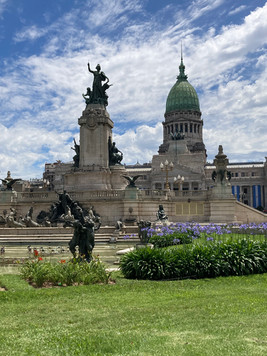
Congreso de la Nación Argentina – As the name suggests, this is the Congress building. It is absolutely stunning! Situated in a big park with a large statue at the center, and grass/trees all around, it provides a great place to take a stroll and let your pup stretch its legs (all while admiring this massive Greco-Roman styled structure, and equally beautiful buildings around the square). I also highly recommend seeing it at night, when it is brilliantly lit-up, adding another dimension to its beauty.
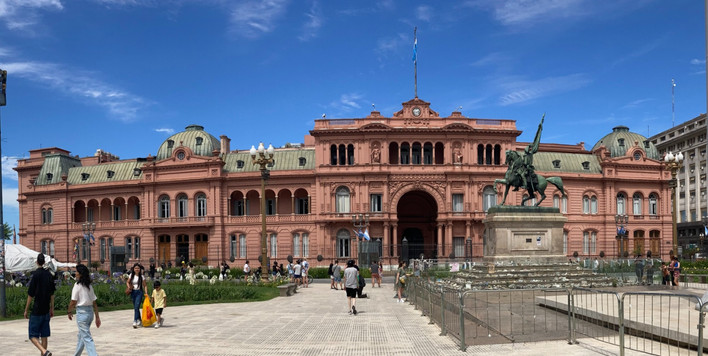
Plaza de Mayo – A city square that features Casa Rosada at its center. Casa Rosada is like the White House of Argentina. This unique building stands-out with its contrasting architectural style and paint color, making it a must-see! While touring Casa Rosada is possible, I faced issues with the website, and booking tours seemed impossible (especially in English). I'll provide the link that was recommended to me onthe ExpatsBA.com forum, just in case someone gets lucky!



Things I learned in my 3rd and 4th week of BsAs.
Dog-Related Shtuff
I finally had to replenish my dog food! Dog food is readily available at pet stores, some grocery stores like Carrefour or Jumbo, and veterinary offices. Veterinary offices so far seem to just be a pet store/pharmacy combo; I have yet to see a vet’s office like what you would find in the US and other countries. Unlike the large 30-50lb dog food bags common in the USA, dog food is typically sold in individual baggies here. You can also find 3kg options, but larger sizes seem uncommon. The dog food is provided in pre-weighed plastic bags, sourced from larger factory bags (AKA, you have no idea what's actually in them, after they were re-sealed, and there is no label). Unless you get your food at a grocery store! ...those are in the factory bags, along with real bags from bigger pet stores. Local brands dominate, although Royal Canin and Purina ProPlan are common. On a personal note, I experimented with a local brand that resulted in increased bowel movements for my dog, possibly due to fillers or too much fiber (I’m talking 4 times a day!). Switching to Royal Canin restored his normal poop schedule this week. There is something fishy about the food in Buenos Aires, so be careful your dog isn't missing micro and macronutrients because he/she is eating discounted, fake dog food with fillers!
The prevalence of dogs wearing muzzles is surprisingly high compared to what I'm accustomed to in the US and other parts of the world. On a daily basis, I encounter around 4-5 dogs with muzzles. Additionally, approximately every 3-4 days, dogs, super aggressive, attempt to charge at my dog, necessitating owners to physically restrain and pull them away. So far most owners with these dogs are pretty on it, but I am always worried one is going to escape its owner. This has been very different than the 10 states my dog has been to in the USA.
Barking is incredibly common here. It's not uncommon to witness dogs on leashes barking persistently for up to 5 minutes while their owners carry on with their conversations, seemingly unaffected by their pet's vocalizations. Whether on balconies, terraces, in parks, or on the streets, leashed or unleashed, dogs in Buenos Aires continuously sing (bark) you the song of their people.
Food/Beverages
The tap water here is safe to drink, although I experienced some initial tummy-shame for about three days (it coincided with consuming room-temperature cheesecake (tarta), making the root cause debatable. However, for the past 4 weeks, I've been consistently drinking tap water without any issues (drink the cold-water from the faucet, not the hot water/mixed part that runs through the probably-dirty water heater tanks). While I try to de-chlorinate the water by filling jugs and then leaving the bottle cap off for 24-48 hours, I also drink it directly when necessary, and haven't encountered any problem like you'd find in some parts of Mexico (Montezuma's Revenge).
Eating healthily has proven quite challenging. Restaurants in this area typically don't include a variety of vegetables in their meals as we might expect in the US. A dish labeled with verduras (veggies) often translates to a main dish, with lettuce and tomato on the side (rather than a grilled/sauteed combo of veggies like carrots and broccoli). Salads typically feature warm butter lettuce, tomatoes in large pieces, tons of raw onions, and occasionally raw mushrooms, and the Caesar dressing here is basically just mayonnaise (don't even bother with Caesar salads; you will be sad). In an attempt to diversify my veggie intake, I bought carrots and bell peppers at the local grocery store—unfortunately, the matchstick-sliced carrots were fully fermented in the bag, but the bell peppers were good! Bags of mixed greens/lettice/lechuga are almost always gooey and decaying in the bag (at stores like Carrefour Express, Dia, etc.). It seems here you need to visit specific stores for particular items, akin to European towns. A local fruit/veggie stand provided me with bananas, blueberries, and strawberries at a reasonable price (like $4 USD for a bunch of good fruit!). I also explored a 'health food' store, where I found genuine peanut butter (without seed oils, sugar, or salt) and organic honey and ground cinnamon - perfect for my morning PB and banana toast! Finding canela molida (ground cinnamon) is hard at the main stores, for some reason. Finding coffee without added sugar has also been a real pain; Argentina is one of very few countries that allows café torrado to be sold, which is a type of poor-quality coffee bean, coated with sugar and overly-roasted, so your instant/ground coffee is never truly pure (not to mention harmful for diabetics). https://www.mdzol.com/sociedad/2021/7/19/cafe-torrado-prohibido-en-el-mundo-pero-permitido-en-argentina-173055.html
The bright side of Buenos Aires is: if you enjoy sweet pastries, honey-covered croissants (half-moons or medialunas), and sweet drinks, the numerous cafes offer a plethora of options, with dulce de leche being THE featured flavor on every menu. You actually can't go anywhere without seeing Dulce-de-Leche-flavored everything. It made me wonder if Argentines know that it's just caramel, and shouldn't be the main flavor of everything ;)

When I first arrived in Monserrat, our taxi driver raved about the dessert dish pan dulce at Plaza Mayor, a restaurant on our street. She insisted it was the absolute best in the world, with lines of people waiting for their sweet bread. Pan dulce is a long-standing holiday tradition, and it had the entire block lined-up literally every day, just as my cab driver said. Determined to try this iconic holiday dessert, I braved the lines. Two friendly ladies in line shared their annual tradition of getting pan dulce, emphasizing the choice between fruit or no-fruit (some people like the plain bread without dried fruit chunks inside). I wanting the full experience of con frutas, from the most-famous place, so after paying 9,000 ARS or $10 USD for the beautifully-wrapped pan dulce (1 kilogram, so they say), I left with high expectations. However, upon unpacking, I was greeted by what can only be described as a fruit cake. Dry in texture, and overflowing with nuts and peculiar freeze-dried jelly/fruit candies stuffed inside (too much...like you can't even really taste the sweet bread), topped with what I think was huge pieces of candied dates...to put it nicely for my argentino friends, it seemed more a tradition than a culinary delight. To double-check my assessment, I've since tried two other pan dulces without nuts – one with just fruit, and one with chocolate chips (reminiscent of a wheat chocolate-chip muffin, that paired well with coffee). But overall I would not recommend the pan dulce unless you enjoy, well...average-tasting fruit cakes!

Culture
Beggars: if you're seated at an outdoor table on one of the busy streets, expect to be approached by individuals seeking money. Whether they're selling a product (tissue packs and socks...wtf), sharing a sad story, or expressing their financial struggles, encounters are inevitable. Surprisingly, even children might approach you! I experienced this firsthand while enjoying a beer on Av. Corrientes, with three different approaches in less than 30 minutes. This is more than in places like Rocky Point, Mexico, surprisingly. This wasn't a phenomenon in Villa Crespo, or in Palermo's ritzy areas, or the poop-filled streets of Monserrat/Congreso, so it's something to consider when choosing your location. According to the waiter, most people simply ignore them, and eventually, they move on. This has been my strategy to navigate such situations, but it definitely made me not want to sit at an outside patio on a busy street, which is hard to opt-out of when you bring a dog!

When you sit down at a restaurant, bar, café, or any establishment, the initial service is fairly prompt – menus are brought, drinks are usually ordered. However, after this, the waitstaff might disappear, leaving you waiting to place another drink or a food order. Here's something hard for polite folks from the USA or elsewhere: in Argentina, the cultural norm is to flag someone down when you need assistance, which is not considered rude. Unlike the USA where servers make regular scheduled visits for drinks, apps, entrees, checking on the food, refilling drinks, offering the check, suggesting dessert, etc. (where flagging down a waiter might lead to managerial involvement), here it's expected. Making eye contact and gesturing to your waiter is the norm, although it still feels somewhat challenging for me. You will be left alone for a long time, if you don't get attention with words or a gesture, and specifically ask for what you need next :P
Since the presidential inauguration, President Milei has been actively issuing new emergency orders (DNU in Spanish) and de-regulating various sectors. I inadvertently witnessed the first protest of his presidency while dining at my usual spot (good beers and great kitchen in Monserrat, mentioned later). A woman on the street corner began banging on a pot with a wooden spoon, followed by more pot-bangers (piqueteros or picketers/professional 'protestors'). Curious about this annoying noise during dinner, since I was nowhere near a government building, I asked my waiter for the details. He explained that the protest was related to Milei, and it was happening a few blocks away. According to my waiter, many protestors are allegedly paid by the previous presidential family, the Kirchner family/Welfare Mafia. They purportedly finance these 'demonstrations' to influence government agendas and express their discontent with Milei. The frustration among the 'normal' working people, like my waiter, is palpable. Argentines seem very respectful about avoiding politics with us Expats/extranjeros, but when asked specific questions, I got a rapid-fire 10-minute response with all the history and their viewpoints. The actual workers work hard and contribute to society, yet these paid protestors often earn more for just blocking roads, burning tires, and causing disruptions to regular people. Additionally, my waiter mentioned that some protestors aren't even Argentine citizens, saying the Kirchners are recruiting individuals from surrounding South American countries, paying them welfare payments if the piqueteros cause enough mayhem to force the Executive/Judicial/Legislative bodies to act (extortion via the mimicry of democratic protests). While stunned, I couldn't help but draw parallels to instances where wealthy families/people have used their money and influence for personal gains and political chaos in the USA and Europe (not mentioning any names like Klaus Schwab or George Soros!). It will be intriguing to observe how this change in presidency impacts the true working class citizens, like my waiter.
Money-related
Some restaurants exclusively accept efectivo (cash), and this information is not always prominently displayed. To navigate this, I've developed the habit of inquiring upfront, 'Do you take credit cards?' (¿Aceptas tarjeta de crédito?). Some places may indicate that they only accept debit (débito) cards, but it's worth trying your credit card or discreetly having them run it, as I've encountered instances where my credit card worked despite the initial assertion (many people don't seem to understand the difference). There have been a couple of places where my credit card was genuinely not accepted, likely due to outdated technology or not-yet-upgraded portable payment machines. Below you will see the machines used almost everywhere that takes cards or ApplePay/contactless payment methods (about half from payment processor MercadoPago).

To navigate the payment world of Buenos Aires, I typically carry around about 10,000 ARS Pesos in cash (~$8 USD today), along with one debit and one credit card. I begin with using my credit card and go from there. Regarding debit cards, it's advisable to bring one without foreign transaction or ATM withdrawal fees; personally, I use a Charles Schwab card, and it has proven to be quite convenient. Make sure you bring a copy of your passport, a photo of it on your phone, and a physical (expired is fine) USA driver license if you can...for when they ask to see your documento to verify it's your card. This has been noticeably enforced beginning around 15Dec2023, and most Chinese-owned grocery stores want a physical passport, which I don't recommend carrying with you for obvious reasons).
Miscellaneous
The information and efficiency, especially with Google Maps, are not as reliable here. When searching for 'restaurants,' only a fraction may appear, despite the abundance of dining options in the area. Even "patio" or Spanish words for your desired cuisine wont give accurate results, a lot of the time :/ Google maps also loves to zoom-out completely away from the area you're searching in. Also, operating hours are quite variable, so it's advisable to take them with...a grain of salt. I recently encountered a place that claimed to open at 5 pm, only to find it was closed on that particular day, all day. Additionally, Google Maps may occasionally direct you to the wrong building or part of the street. While I still use it to get a general idea of locations, or explore some specific places, flexibility is key, and I've often discovered eateries by simply strolling around. To add to this: if a business has altered their hours for an event or holiday or issue, they almost never update their info on Google Maps, nor hang a sign on the door. So, I have walked up to several buildings hoping for a gym class, or a meal, and they're just closed even though Google Maps hours state they're open, leaving me guessing if there's a different door or I'm missing something.
Dog-Friendly Restaurants of Monserrat!

Bonnie & Clyde
Av. Independencia 1215, Monserrat, CABA, C1099, Argentina
Outdoor seating with your pup! Inside...no pups. The staff are super sweet, beers are good and cheap! 1,700-1,900ARS or about $2 USD today for a pinta. This is the first place I have had a decent salad! It's the Bonnie salad with crispy chicken - yum! Thin, sweet, honey-mustard dressing with a little kick. And their burgers are also great! Best french fries/papas so far in a month of Buenos Aires, and they actually bring you packets of ketchup/mustard/mayo to blend some Mormon Sauce!
Armin Bar
Salta 774, Monserrat, C1074AAP, CABA, Argentina
This is more of a bar scene, but their food is pretty good, and the staff were above-and-beyond making me feel welcome and smooching my dog :) The burger was tasty and their pizza is more like a flatbread - the best pizza i've had in the area (Pizza Guerrin is a tourist trap and sucks, and overall Buenos AIres pizza is horrible Pizza-Hut-crap-cheap pizza). They also have specials, and their beers are tasty and inexpensive as well (I got the 1-liter Andes Negra bottle). The owner is young, and it is always the same 3 people working there...they are so kind and allowed my dog inside (can't guarantee that's allowed, but they were awesome when outside was filled with smokers and we wanted to be inside). They also continuously came over to greet and pet him throughout each meal (yes they washed their hands, dog-haters). I hope they make a ton of money!
TequePizza
Salta 603, Monserrat, C1074AAM CABA, Argentina (this address shows a different restaurant, but its for sure Teque Pizza...like I said, Google Maps isn't super accurate in Buenos Aires for a metro area of 13 million people!).
This is not a dog-friendly place inside, but I still wanted to give them a shout-out because they had the second-best pizza in the city so far! Well, first-best if you aren't counting the Armin flatbread style, since Teque has traditional large pizzas with pie slices. I got the bbq chicken pizza and it was good! It still is not like the pizza in the US, but with the cafeteria pizza I have been consuming, this was heaven! A little dry, and not enough sauce, but overall 8/10 good and I went back...you can even get little mozzarella sticks or tequeños as the crust, thus the name TequePizza.
Next week's neighborhood: Palermo Chico!


Comments